By Charles Homans, Steve Eder, Jan Ransom and Michael Rothfeld Visual analysis and graphics by Helmuth Rosales, Aric Toler and Katherine Chui. Photographs by Andrew Moore and Cait Oppermann
June 16, 2026 [–>
Late in the afternoon of July 6, 2019, about a dozen F.B.I. agents and New York Police Department officers gathered at Teterboro Airport in New Jersey, waiting out of view of the tarmac so as not to spook their quarry. The day before, they received an email informing them that a private jet would be arriving at 5:20 p.m. Attached to the email was an arrest warrant for its lone passenger, Jeffrey Epstein.
Returning from Paris, Epstein was making plans on his phone: a trip to his private island in the Caribbean, a documentary interview with Stephen K. Bannon, President Trump’s former adviser. When the plane touched down, customs agents boarded to check the passports of Epstein and the plane’s two pilots. Then they escorted Epstein into the terminal, where an F.B.I. agent and a detective told him he was under arrest.
Epstein appeared shocked. He managed to send one last message to Bannon: “All canceled.”
Bannon wrote back immediately. “you r not coming in?” There was no reply.
As the F.B.I. agents drove Epstein to Manhattan, he asked two questions. “Is this sex trafficking?” “Is this about underage?” It was.
The F.B.I. and federal prosecutors had quietly opened a new investigation eight months earlier into Epstein’s activities in New York, focusing on victims who had not been interviewed in his decade-old sex-crimes case in Florida. While Epstein was abroad, he was indicted under seal on charges of trafficking minors for sex. If found guilty, he faced up to 45 years in prison — a sentence far worse than the 13 months he had served in Palm Beach after a plea deal in 2008.
“Oh, this is bad,” he said aloud as he was booked into federal custody. “This is really bad.”
An F.B.I. agent and a detective took Epstein to the Metropolitan Correctional Center, a federal jail in Lower Manhattan, shortly after 9 that night. The newly arrived inmate caught the eye of a jail employee named Elba Torres as she passed his cell. Epstein appeared “distraught, sad and a little confused,” Torres reported in an email to the jail staff. When she asked him if he was OK, he replied that he was. “But I am not convinced because he seems dazed and withdrawn,” she wrote. “So just to be on the safe side and prevent any suicidal thoughts can someone from Psychology come and talk with him.”
Neither Torres nor anyone else on the jail staff seemed to have yet identified Epstein as a figure of note. But her memo, written in the early moments of his incarceration, documented an extraordinary reversal of fortune. Hours before, Epstein had been cocooned within a personal empire of luxury and influence that had for years seemed to operate effectively beyond the reach of the law. Now he was in an overcrowded federal jail in an inmate’s uniform, reduced to a Bureau of Prisons number: 76318-054. It was the beginning of a journey into darkness that would end 35 days later, in the early hours of Aug. 10, 2019, when a guard found him unresponsive in his cell, hanging from a noose made from orange jail fabric.
The New York City medical examiner ruled Epstein’s death a suicide. But seven years later, the theory that Epstein didn’t kill himself, that he was murdered by someone with an interest in keeping him quiet, is held by many people who agree about little else. A broader discontent and suspicion around the handling of his death helped prompt the Epstein Files Transparency Act, passed by Congress with bipartisan support in November, which has since resulted in the disclosure of more than three million pages of Epstein-related documents, photos and videos.
These include tens of thousands of pages of documents and hundreds of hours of video gathered in the official investigations into Epstein’s death: an initial inquiry by Justice Department prosecutors with F.B.I. agents and New York City detectives and a yearslong investigation by the Justice Department inspector general, both of which concluded that Epstein died by suicide.
The newly released records have raised more questions about his death — but they have also offered the clearest opportunity yet to answer them. Over the years, The New York Times and other news outlets sued for records from these investigations, but even those hard-won documents were dwarfed by the volume of what was now public. Congressional action had made possible the fullest examination yet of Epstein’s death, and we set out to do it.
Working from the documents, we found and interviewed as many people as possible who interacted with Epstein during his arrest and incarceration or participated in the inquiries into his death. We spoke and corresponded with more than 40 inmates, jail employees, lawyers, federal officials and law enforcement officers connected with the case — many of whom had not been previously interviewed by reporters. Notably, many had also never been interviewed by investigators. We also spoke with Epstein’s brother, Mark, and a pathologist he hired to attend Epstein’s autopsy, as well as other pathologists with no involvement in the case. For many more people connected to the death and its investigation who declined to talk to us, we consulted newly released notes and transcripts from the investigators’ interviews.
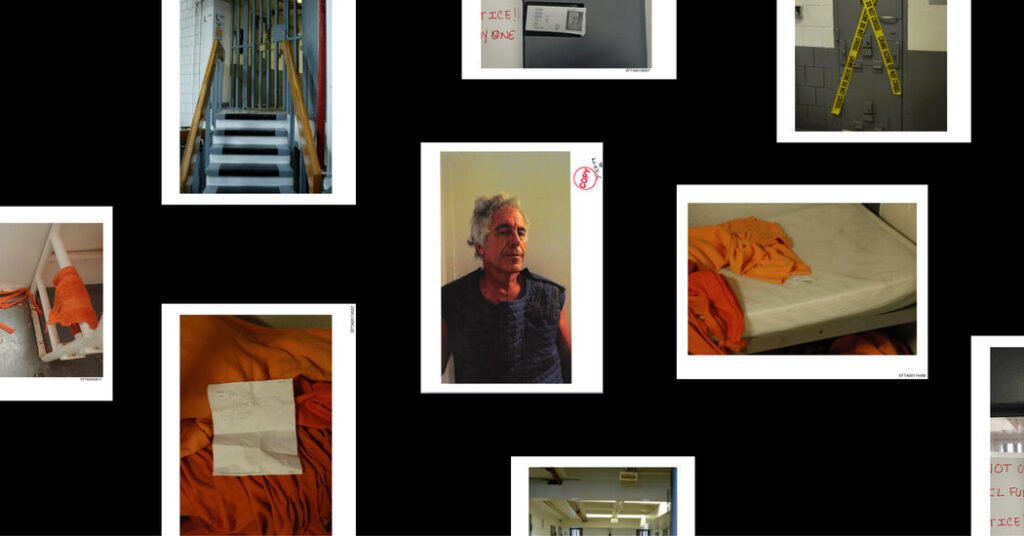
We went to court to win access to a document that had been described as a suicide note written by Epstein in jail before an earlier apparent attempt to take his own life, which was hidden from the public and investigators for years. We obtained about a dozen pages of other notes handwritten by Epstein in jail that were also previously unseen — including some in which he tried and failed to come up with significant information he might have on Donald Trump to offer to prosecutors. And we worked with colleagues who specialize in open-source visual investigations to analyze photographs and video footage from the unit where Epstein was housed and create a 3-D model of it. We considered every plausible theory of Epstein’s death, both official and otherwise, seeking out the most persuasive arguments and evidence for each.
That the official account of Epstein’s death would come under suspicion was all but inevitable. Epstein was a man of extraordinary yet hazily explained wealth, with private-plane manifests full of executives, dignitaries and even former heads of state, and a record of lurid sex crimes involving teenage girls. This profile, already fertile ground for conspiracy theories, became radically more so after his death. And the facts, as they emerged, were rife with odd-seeming coincidences, outwardly baffling decisions and credulity-straining mistakes and oversights.
At the time of his death, Epstein was alone in his cell in spite of clear guidance to the contrary, while the guards assigned to his section of the jail neglected to conduct their rounds for hours. The jail’s security-camera system partially failed, and the video it did record showed an orange blur — the color of an inmate’s uniform — moving toward Epstein’s corridor shortly before his death. After Epstein’s body was found, evidence from his cell was not cataloged carefully, and photographs and objects gathered there seemed difficult to reconcile with aspects of his autopsy report. Two pathologists present at that autopsy had differing interpretations of the injuries to his neck.
There were so many people with an ostensible stake, one way or another, in Epstein’s death. Was it possible that all of this just happened?
Some important questions about Epstein’s death remain unanswered and likely unanswerable. Nevertheless, our reporting establishes that Epstein showed a clear pattern of behavior in the weeks before his death suggesting an intent to kill himself. The apparent suicide note memorialized Epstein’s despair and desire to “say goodbye” on his own terms. Other writings from his final days presented a picture of a fraying mental state that sharply contrasted with the upbeat picture he presented to jail psychologists, including another note in which he hinted at ending his life.
[0–>
In addition to this, we were told by a former cellmate that Epstein made more than one previously unreported attempt to craft a noose. And we located a former inmate, never before interviewed, who was housed in a neighboring cell at the time of Epstein’s death and whose account circumstantially supported the conclusion that Epstein died by hanging himself. Consulting with independent pathologists, we determined that a likely error in cataloging evidence from his cell created the appearance of mysteries regarding his injuries that were, in fact, potentially explained by other evidence from the scene that was overlooked at the time.
The picture drawn most clearly by this new information is not the elaborate conspiracy that his murder would have required; rather, it is an unfortunate though not improbable convergence of longstanding institutional failures, human errors and chance events, which created an opportunity for Epstein to act on what was by then a well-established desire that he had already tried and failed to realize.
“ONLY PAIN TO ME & others in the future,” he wrote during his incarceration. Days later, a chance for him to escape that future would present itself. This is the untold story of how it happened.
‘He seemed a bit shellshocked’
[0–>
Besides Epstein himself, the most important character in the story of his death is not a person but a place: the Metropolitan Correctional Center, a Brutalist monolith infamous among federal prisoners and lawyers for its poor conditions and dysfunction. The M.C.C., which housed federal criminal defendants prosecuted by the Southern District of New York, was overcrowded and so squalid and crumbling that Bureau of Prisons officials would later warn that it posed a safety and security threat to inmates and employees alike. (It was closed in 2021.)
The building was stiflingly hot in the winter and freezing cold in the summer, leading inmates to hoard stashes of extra sheets so they could sleep through frigid nights. Many of the M.C.C.’s corrections officers worked second jobs or exhausting overtime schedules to make ends meet. More than a few extracted income from the jail’s thriving underground economy, which was a reliable source of federal indictments for smuggling contraband.
The M.C.C.’s highest-profile inmates were usually housed in a maximum-security unit on the 10th floor of the southern wing, a jail within a jail where they were isolated from other prisoners and kept under 24-hour video surveillance. The unit, known as 10 South, had held all sorts of violent, vulnerable or potentially suicidal criminals: Joaquín Guzmán, the Mexican crime lord known as El Chapo; Mafia hit men; terrorists from Al Qaeda; Bernie Madoff during his own pretrial detention a decade earlier. But there is no indication from the investigation documents that it was ever considered for Epstein.
New York’s state-run facilities have protective custody units reserved for inmates who are high profile or otherwise potentially in danger in prison. The M.C.C. did not, and instead sometimes placed them in the special housing unit, or the SHU. The SHU was punitive by nature — inmates were held in cells for 23 hours a day and sharply limited in their contact with the outside world — and research has shown that prolonged isolation in such conditions can exacerbate mental illness and increase the risk of self-harm and suicide. This was where Epstein would spend most of his time in the M.C.C.
At first, however, little attention seems to have been paid to his arrival at the jail. Although his arrest was already widely reported, when he was taken to the rear gate of the jail on the night of July 6 he was not processed as a high-profile inmate. As a result, he was placed in the M.C.C.’s general inmate population that night.
An inmate named Peter Bright recognized Epstein when they crossed paths in the unit to which they were both assigned. Epstein was “not very communicative,” he recalled. “He seemed a bit shellshocked.” The unit, 5 North, had a reputation among M.C.C. inmates as a particularly rough part of the jail, and trouble found Epstein there almost immediately in the form of another prisoner who went by Loco Tron.
Two other inmates recalled that Loco Tron accosted Epstein. “He was trying to get money out of him,” one of them, Luis Fernandez, told us, recalling what Loco Tron had told him. “He was trying to scare him.” Another inmate, Dayvon Williams, said he intervened to stop him.
On July 7, Lamine N’Diaye, the M.C.C. warden, who had by then identified Epstein and recognized the risks he faced in general population, ordered him moved to the SHU. The SHU’s use as an ad-hoc protective custody unit had the perverse consequence of placing some of the jail’s most vulnerable inmates alongside some of its most violent. So it was that Epstein was led up to the SHU that evening and introduced to a muscular man with a shaved head named Nicholas Tartaglione, with whom he would be sharing his cell.
After the door shut behind him, Epstein, visibly nervous, asked Tartaglione what he was in for. Multiple homicides, Tartaglione told him.
Epstein turned and pounded on the door, shouting for the guards.
‘How do you make a noose?’
[0–>
Tartaglione, a 51-year-old former police officer, was awaiting trial on federal charges of killing four men, one of whom was strangled with a zip tie. (He has since been convicted and has appealed.) As strange as it might seem, his selection as a cellmate for a prisoner who presented safety concerns, like Epstein, reflected conventional, if counterintuitive, wisdom among corrections officials: Inmates charged with serious crimes had the most to lose by committing new offenses in prison.
Contacted recently at a maximum-security prison in California where he is serving four life sentences, Tartaglione told us that when he asked the guards why he was put with Epstein, they said, “You’re the only guy who won’t beat him up or extort him.”
The next morning, Elissa Miller, the jail’s chief psychologist, placed him under temporary psychological observation in a special cell, citing “multiple risk factors for suicidality” because of his sex-crime charges, but quickly returned him to his cell with Tartaglione. This, too, had a clear logic.
Suicide is an omnipresent threat in prison. It is also a private act that prisoners are less likely to attempt when they are around other people, and a cellmate can generally be counted on to stop a suicide attempt or alert the guards — if not out of compassion then at least out of self-interest. Saving another inmate’s life avoids implication in a suspicious death and might even be factored into sentencing.
But Miller also came away from her early meetings with Epstein relatively unconcerned about his suicide risk. In their conversations, he seemed to her to be in a positive mood. He spoke optimistically about his prospects for being released on bail in advance of his trial, and blew off the notion that he posed any threat to himself. He had a “big business” to attend to on the outside, he told her. And besides, he said, “being alive is fun.”
But over the next week, the forecast clouded for him. During his bail proceedings, Epstein’s lawyers proposed that he await trial in home detention in his Manhattan townhouse, ensured by a substantial bond. Federal prosecutors argued against his release, maintaining that he posed an extraordinarily high flight risk based on his wealth and international connections. On July 18, his 13th day in jail, a federal judge agreed, denying him bail.
Tartaglione told us that when Epstein returned to their cell from court that day, he asked abruptly: “How do you make a noose?”
In the days that followed, Tartaglione said, he caught Epstein preparing for suicide twice — an account that the inmate Peter Bright also recalled hearing from Tartaglione shortly after Epstein’s death. Once, Tartaglione said, he noticed Epstein trying to tie a sheet to the grate over the cell window. Another time, he woke up to Epstein standing in the dark looking “a little suspicious” and discovered a noose hidden under his mattress.
Tartaglione told us he reported both attempts to guards, but they did not seem to take them seriously, laughing him off. (We could find no mention of these attempts in the jail records released in the Epstein files.)
At this point, Epstein’s only regular connections outside the M.C.C. were his lawyers, a seemingly never-ending parade of mostly young attorneys who met with him in the jail’s legal-visit room. Although they were ostensibly there to plan his defense, they knew their real role was to provide a highly compensated form of companionship and a pretext for Epstein to remain out of his cell as much as possible.
They sat with him for hours at a stretch, often to the annoyance of other inmates and their lawyers, who also needed to use the room. They listened as he seethed about the former friends who were now publicly distancing themselves from him, like Leslie Wexner, and tried to figure out whether he had any leverage to use against former associates like Bill Gates. Once, they heard him mutter: “I can’t do this.”
His attorneys discussed with federal prosecutors the prospect of a proffer: giving them information that might be useful in other cases in exchange for the possibility of some leniency in his own. Epstein was particularly preoccupied with what he might have on Donald Trump, who was then serving his first term in office. Jotting on a legal pad, he returned to the president again and again, trying to dredge up anything to offer prosecutors. But his scribblings — “Trump is a total con artist — smoke & mirrors” and “Never had money”— suggest that he could come up with little that wasn’t already known.
Epstein’s writings were mostly elliptical, jottings rather than complete thoughts, riddled with his distinctive idiosyncratic capitalization and punctuation — but revealing all the same. He wrote about the frustrations and humiliations that came with being seen as a wealthy “Pedophile in jail.” He was denied phone calls and personal visitors, and it was “impossible to mount a defense” with the incessant noise of the SHU — “no sleep, no air, screams.” The guards, Epstein wrote, told Tartaglione that “if he beat the shit out of me, they wouldn’t file a report.”
On July 22, four days after his bail was denied, he wrote across the top of a piece of paper in large letters: “J’ACCUSE.” It was an apparent reference to Emile Zola’s 1898 public letter denouncing the French government for the biased prosecution of the Jewish army officer Alfred Dreyfus on treason charges of which he was later exonerated. A fragmentary rant followed down the page. “Me/Too -Jewish-Rich-Politics,” he wrote. “Believe the victim = Believe the accuser — CRAZY!”
Hours later, at 1:27 a.m., the guards on the night shift heard a banging sound coming from the direction of his cell. Arriving on the tier, they heard Tartaglione yelling. Looking through the narrow window of his cell, one of the officers saw Epstein on the floor, motionless, an orange fabric noose hanging loosely around his neck.
‘It is a treat to be able to choose one’s time to say goodbye’
[0–>
Epstein and Tartaglione told sharply divergent stories about what happened that night. Tartaglione said that he had been on his mattress on the floor, sleeping with headphones on, when he felt something bump against his legs. Epstein was in a seated position, his back against their bunk bed, dangling from the noose. Tartaglione cut him down with a razor he had hidden in the cell, he told us, and, recalling his police training, began chest compressions.
When the guards arrived at the cell moments later, Epstein was breathing but still unresponsive. As he regained consciousness, he appeared unable to stand. The officers cuffed him and placed him on a stretcher, carrying him off to an observation cell near the jail psychologist’s office. He was put in a rip-proof suicide smock and left there for the rest of the night.
The first detailed memo about the episode was written early the next morning by Glenda Anderson-Layne, the operations lieutenant on duty that night, who reported that Epstein behaved oddly after regaining consciousness. His eyes were open, but when anyone made eye contact with him, he quickly shut them. In the observation cell, he sat on the edge of the bed and slumped forward, falling over, but as soon as the lieutenant looked away, he straightened up, as if it were all a performance. Anderson-Layne told him she would cuff him for his own safety if he repeated the act. “OK, I won’t do it again,” he told her and flashed a thumbs-up.
Anderson-Layne tentatively described what happened the previous night as a “possible suicide attempt.” Epstein’s own story was inconsistent. At first, he told corrections officers that Tartaglione tried to kill him, an account he later repeated to another inmate, according to jail records.
But later that day, he claimed to a jail psychologist that he had gotten up to get a drink of water around 1 a.m., and the next thing he remembered, he was lying on the floor surrounded by jail staff members, with no recollection of how he got there. He gave a third explanation to David Schoen, a lawyer who met with him in jail a week later, telling him that the incident began with a “prank” Tartaglione “sort of forced on him,” Schoen told us, and that he made up another story to tell the guards.
When Miller, the chief psychologist, wrote her own memo about Epstein the morning after the episode, she noted that it was “unclear at this time” what exactly happened. She was, by then, approaching Epstein with some skepticism. In their meetings, he demanded all kinds of special treatment, seemingly regarding her like a personal assistant. She was forced to squeeze in these meetings around his marathon sessions in the legal-visit room, where Epstein and one of his attorneys mocked her for thinking he might be suicidal.
Considering the incomplete facts and conflicting accounts, Miller believed there were three plausible explanations. One was that Epstein really was suicidal and that the attempt, clumsy as it was, was a kind of rehearsal. Another was that Tartaglione attacked him.
The third was that Epstein, Tartaglione or both were trying to game the jail system. It was common enough for inmates to claim to be suicidal in order to get away from a particular guard or to get a new cellmate. Miller knew Epstein had recently been denied bail. It seemed possible, she later told investigators, that he was trying to send a message: “‘I can’t take jail. Put me on house arrest. I’m either going to hurt myself or someone else is going to hurt me. Get me out of here.’” Epstein “came in very entitled,” she went on. “He had a lot of money. He was meeting with his attorneys every day.”
There was one piece of evidence that might have convinced jail officials that Epstein was serious about taking his own life — but at the time, they didn’t know it existed. It surfaced soon after the incident, when, Tartaglione told us, he picked up a graphic novel that he had been reading and found a piece of paper tucked between the pages. It appeared to be a suicide note, in Epstein’s handwriting.
[0–>
“They investigated me for month — Found NOTHING!!!” Epstein had written, fuming about the revival of “15 year old charges” against him. “It is a treat to be able to choose one’s time to say goodbye,” he went on. “Watcha want me to do — Bust out cryin!! NO FUN — NOT WORTH IT!!”
Tartaglione did not report the note to officials at the M.C.C. Instead, he gave it to his lawyers. Its value to him was clear enough. At the time, he was potentially facing the death penalty. The note would not only dispel suspicions that he had attacked Epstein, but it might also support his account of playing the hero during Epstein’s would-be suicide attempt, saving his life.
Bruce Barket, a lawyer for Tartaglione at the time, told us in an interview that he contacted Epstein’s attorneys and warned that he had information to counter Epstein’s claims that Tartaglione attacked him. Barket told us he planned to present the note in court or at an administrative hearing if action were taken against Tartaglione. “Look, we have objective, extrinsic evidence that this was a suicide attempt,” Barket recalled telling Epstein’s lawyers. Epstein backed off his claims, telling jail officials he had no issues with Tartaglione and felt safe being housed with him.
As for the note, it ended up sealed in Tartaglione’s own court filings, out of public view. “Our obligation isn’t to the jail to help them do their job or to Epstein or his family or anybody else on the planet,” Barket told us. “Our job is to protect our client.” As a result, the note was not seen by the jail staff at the time, or even by investigators looking into Epstein’s death in the weeks and years to come. It was made public only this May, after The Times’s lawyers petitioned the judge in Tartaglione’s case to unseal it.
There are several reasons to believe that the note, as oddly as it reads, is authentic. The handwriting closely resembles the handwriting in Epstein’s other jail notes. The penultimate sentence (“Watcha want me to do — Bust out cryin!!”) is a phrase from the “Little Rascals” film and TV franchise that Epstein occasionally dropped into emails to close friends and family — a personal flourish that Tartaglione was exceedingly unlikely to have known about.
Most revealing, the same phrase, in the same handwriting and with similar irregular punctuation, appears among the notes Epstein scribbled at the M.C.C. In one of these notes, Epstein wrote: “ONLY PAIN TO ME & Others in the future. NOT very much fun! Why should people I Lov suffer for my problem. So … Watcha want me to-do? …. Bust out cryin!! Best for all.”
[1–>
These notes, with their intimations of suicide, raise one of the great counterfactuals of Epstein’s incarceration: If the jail psychologists had known about them, would they have treated him differently? Instead, in her report the day after the episode, Miller described Epstein’s acute suicide risk as “moderate” and his chronic suicide risk as “absent.” Later that day, his status was downgraded from suicide watch to psychological observation.
For the next six days, he remained in the observation unit by the psychology office. The cells there were spartan even by jail standards, containing only a single mattress on a metal frame, a toilet and a sink. The front walls were clear, allowing the inmates to be observed at all times. The task of watching them fell to a rotating crew of “inmate companions” usually assigned to four-hour shifts, who monitored the cells’ occupants and recorded updates on their behavior every 15 minutes in a watch log.
William Mersey, one of the companions assigned to Epstein, was the proprietor of an escort advertising service and was at M.C.C. on a brief sentence for tax evasion. Like Epstein, Mersey was a Jewish New Yorker in his 60s, whose amiable chatter, he recalled, seemed to put Epstein at ease. Sometimes during their conversations, he told us, Epstein would drift off despairingly. Mersey assumed he was “thinking about how he is going to spend the rest of his life in prison,” he told us. “He looked defeated.”
Epstein made a similar impression on another inmate companion, Michael Tisdale, who was watching Epstein the evening after the July 23 episode. “Everything OK?” Tisdale asked him.
“It’s all right,” Epstein said, according to Tisdale. But it wasn’t clear that it was. “This is a really different world,” he went on. “A really crazy world.”
Miller planned to take Epstein off observation and return him to the SHU on July 29. When they met that day, Epstein insisted again that he simply could not remember what happened and suggested that perhaps his memory was impaired by his sleep apnea; he was awaiting delivery of a CPAP machine, a commonly prescribed device that would help him breathe in his sleep. He asked if he could stay in the observation cell for another week. It was “safe” there, he said.
Miller said he could stay one more night. But then he had to return to the SHU. There were “no mental health issues” precluding his return, she wrote in an email.
‘He’s not good to be alone’
[0–>
Epstein was not placed back with Tartaglione when he returned to the SHU on July 30, three weeks into his incarceration. His former cellmate had not yet been cleared of any wrongdoing in the apparent suicide attempt, an M.C.C. warden would later write. Instead, Epstein was placed with Efrain Reyes, a 50-year-old Bronx native facing charges in a drug-trafficking case. Reyes was housed in the SHU because he had been extorted and threatened in his previous unit and was cooperating with prosecutors in another case.
The two men were placed in Cell 220 on the SHU’s L Tier. Each eight-cell tier in the SHU had its own locked door and was reached from the unit’s central common area by a short flight of stairs. The guards’ desk sat in a corner of the common area near the stairs to L Tier. Cell 220, chosen for its proximity to an electrical outlet in the corridor that would allow Epstein to use his CPAP machine, was also one of the closest to the guards’ desk.
The guards brought in two mattresses so Epstein could sleep on the floor, as Tartaglione did in Epstein’s previous cell — a violation of M.C.C. policy, but one that was rarely enforced. Epstein, following Tartaglione’s example, positioned the mattresses in a corner where he would not be visible through the window in the door. It made Reyes nervous. “Please don’t do nothing while I’m in here,” Reyes recalled telling Epstein. “I have a chance to go home soon.” He added: “I don’t care what you did. That’s all I ask. If I can help you, let me know.”
As a cellmate, Reyes proved to be a thoughtful choice. He struck the investigators who interviewed him after Epstein’s death as genuinely well intentioned. On their first night in the cell, he noticed that Epstein still had not learned how to make a jail bed, and he showed him how. Epstein seemed to appreciate that, and he returned the favor by getting Reyes a radio and a bar of soap from the commissary.
The guards were on “eggshells” around Epstein, Reyes noticed. He was always making demands, and if they did not comply, he would make a show of writing down their names, telling them that he would talk to his lawyers. They seemed to approach Epstein deferentially, allowing him to keep items like extra pens and bedding that were officially forbidden for safety reasons — an obvious concern with Epstein, as officials knew.
Robert Adams, a corrections officer working at the M.C.C. at the time, said he was “dreading” dealing with Epstein for fear that he would somehow suffer consequences from his legal team. He recalled that once, when he returned Epstein to his cell after a full-day session with his lawyers and gave him a meal, Epstein asked for his name. Fearing the worst and panicking, Adams gave him someone else’s. But instead, to his surprise, Epstein said to him, “Thank you for treating me with dignity and humanity.” Adams thought Epstein appeared “downtrodden,” like “a lion taken out of the jungle and put in a cage.”
Jail officials had been formally warned of continuing concerns about Epstein’s mental health. On July 31, the day after Epstein was sent back to the SHU with a clean bill of mental health from Miller, the U.S. Marshals Service, which escorts inmates between jail and court, flagged him with an “alert notice” upon his return from a court hearing, noting that he was showing “suicidal tendencies.”
As Epstein continued to spend most of his waking hours in the legal-visit room, there were moments that would in retrospect seem ominous to his lawyers. Once they saw him examining a computer cable. Epstein, noticing their attention, reassured them that he was too much of a “coward” to kill himself. Most fatefully, he made an unusual request: He told them he wanted to update his will.
One night, Reyes recalled, he woke up to see Epstein fidgeting with a piece of fabric — a clothesline that Reyes made out of a bedsheet, as M.C.C. inmates often did. “Bro, we not doing this,” he said he told him, and flushed the line down the toilet. Epstein insisted to Reyes that he had never attempted suicide during his incarceration, but he wondered aloud about how he could live in prison. “Don’t try to kill yourself in this cell,” Reyes told him again in one of their conversations. “I don’t want to wake up and find you dead.”
“Don’t worry,” Epstein told him. “I’m never going to cause you trouble.”
With little to do, Epstein and Reyes watched the corrections officers. The cell window, looking out onto the guards’ desk, provided a view of their regular derelictions of their responsibilities. Once, around 5 in the morning, Reyes woke up for a smoke and saw the guards sleeping, huddled in orange prisoners’ sheets against the cold of the air-conditioning. “Look, they’re using our blankets,” he told Epstein. “They’re asleep.”
“Fucking incredible,” Epstein said.
View from Epstein’s cell
Reyes would return occasionally to the subject of Epstein’s apparent attempted suicide. “You tried to off yourself,” he recalled asking one night. “Why? You got money. You can pay for protection.”
Epstein told Reyes he was extorted during his brief stay in 5 North. “That’s the hottest house,” Reyes told him.
“They threw me to the wolves,” Epstein said.
“You can live in jail,” Reyes insisted. Epstein, he said, replied that the government was mad about the plea agreement he had negotiated in Florida. “I know I’m never going to see the street again,” Reyes recalled him saying. He told Reyes that prison was “no way to live.”
On the morning of Aug. 9, Reyes was transferred to a private detention facility in Queens that was often used to house inmates who were cooperating in other prosecutions. As he left the tier for the last time, he told a jail staff member to look out for Epstein. “Get him a good bunkie,” Reyes said. “He’s not good to be alone.”
Reyes was not the only one who understood this. Because of Epstein’s suicide risk, Miller had ordered him housed with another inmate at all times. Several corrections officers throughout Aug. 9 noted that Epstein had not been assigned a new cellmate and later said they passed along the information. But no one resolved the problem.
On the day that Reyes left, a cache of particularly damaging documents was unsealed and made public in a defamation lawsuit filed by one of Epstein’s victims, Virginia Guiffre. Epstein held what would be a final meeting with his lawyers that day and ended it earlier than usual. That evening, it would later be discovered, a supervisor named Nathaniel Bullock allowed Epstein to make an unmonitored phone call. Epstein told Bullock that he wanted to call his mother, who had been dead for 15 years.
In fact, he called his girlfriend, Karyna Shuliak. “They are trying to keep me safe,” Epstein said of the guards, according to an account of the call that Shuliak’s lawyers later gave to investigators. His case would take longer than expected, he said. He told her that he would not be able to call for another month, that she should be strong and that he loved her.
After the phone call, Epstein was escorted back to his cell. He found it empty. No new cellmate had been sent to join him. He was alone.
‘We’re going to be in so much trouble’
[0–>
The two officers on duty in the SHU late that evening were Tova Noel and Ghitto Bonhomme. Noel, who would stay on through the morning, had worked at the M.C.C. for just over a year. Although she had not received any specific training for the SHU, where she had worked for less than two months, she later told investigators that she had been instructed to sign documents saying she had. She routinely worked 16 hours at a stretch and had, at times, dozed off behind the wheel of her car on her drive home to the South Bronx. Sometimes she called in sick just to get time off from work to sleep.
View from the guard station
None of this was unusual at the M.C.C., which had been battered by years of budget cuts, unfilled vacancies and bureaucratic lethargy in hiring. Understaffing was so severe that six months before Epstein arrived at the M.C.C., Serene Gregg, the president of the corrections officers’ union at the jail, wrote to top Bureau of Prisons officials warning of “a dire situation” at the jail. “Quite frankly, at this point, we are one incident away from a staff or inmate fatality,” she wrote.
The week Epstein died, 11 M.C.C. officers were absent from their regular shifts. The jail was short-staffed enough that desperate supervisors ordered Noel, who was already working until midnight on Aug. 9, to take the overnight shift, too.
Noel conducted rounds — walking past the cells to confirm that all inmates were alive, which officers were required to do twice an hour — shortly after 10 p.m., visiting one tier after another in the SHU. When she passed Epstein’s cell, he called out for her to plug in his CPAP machine. She did and continued on her way. It was the last time anyone would acknowledge seeing Epstein alive.
There were approximately 11 surveillance cameras placed in and around the SHU, positioned to comprehensively cover its common spaces and corridors, though not the interiors of its cells. But M.C.C. technicians had discovered a major hardware failure a week earlier: Nearly half of the system’s cameras, while working in real time, were not recording. The jail staff had gotten replacement hard drives that day but had not yet installed them. As a result, only two cameras in the SHU were recording in the hours before Epstein’s body was discovered. One covered most of the unit’s common area, including the guards’ desk and a sliver of the staircase leading up to the locked door to L Tier. Beyond the door was Epstein’s cell.
Cameras and available footage from the night of Epstein’s death
The camera’s footage is for the most part too low-resolution and blurry to identify individuals and their movements with certainty, which has produced one of the great enigmas in the Epstein case. Around 10:40 p.m., the camera covering the common area momentarily captured, in the corner of its frame, an indistinct orange shape that appeared to move up the staircase toward the L Tier door, most of which was off-camera.
Although the camera does not capture the entire staircase, the footage is the only indication that a person might have entered or exited Epstein’s unit in the hours between Noel’s round after 10 p.m. and the discovery of Epstein’s body about eight hours later. An F.B.I. investigator’s notes on the video suggested that it “could possibly be an inmate escorted up to that tier” — an observation that has fueled speculation that it was Epstein’s killer.
Absent other footage, it is likely impossible to say for certain whose movements are captured in those frames. Bonhomme, who did not respond to multiple interview requests for this article, is not visible in any of the footage from this time period, and his whereabouts are unaccounted for. In a closed-door interview before a congressional committee this year, Noel said that Bonhomme, who by then had worked for more than 22 straight hours, was asleep at the time. Bonhomme told investigators that he did not recall where he was between 10 p.m. and the end of his shift at 12 a.m.
Based on the footage, interviews and jail records, the Justice Department inspector general would later conclude that the shape was most likely Noel — the only other corrections officer on duty in the SHU that night besides an occasionally visiting lieutenant — carrying orange inmate linens or clothing up to the tier. Noel has repeatedly denied this in sworn testimony and interviews with investigators, but two key details support the inspector general’s conclusion.
One is that, as multiple M.C.C. officers testified under oath or told us separately, only one set of keys to the tiers was kept in the SHU, on the person of one of the two on-duty guards. “Officers guarded those keys with their lives,” aware of the consequences if they didn’t, Adams said. A figure that appears to be Noel is seen on the video minutes earlier making her rounds of the other tiers shortly after 10 p.m., meaning she would have had the keys at the time. The other notable detail is that the movement up and down the staircase corresponds with a brief moment in which Noel’s location is otherwise unaccounted for in the video.
When Bonhomme’s shift ended at midnight, he was relieved by a jail employee named Michael Thomas, a 12-year veteran of the Bureau of Prisons. Struggling to keep pace with his rent and child-support payments, Thomas frequently volunteered to work overtime on guard shifts, and this was his third consecutive shift. Thomas was not principally a corrections officer; he mostly handled commissary, laundry and supplies. But confronted by staffing shortfalls, jail officials increasingly used teachers, nurses, clerical workers and other members of the support staff to fill in.
Epstein’s presence, and the extra attention he was now supposed to receive, was indicated by a sardonic sign attached to the computer at the guards’ desk: “MANDATORY ROUNDS MUST BE CONDUCTED EVERY 30 MINUTES ON EPSTEIN #76318-054 AS PER GOD!!!!” Noel told investigators that she tried to do a count — in which two officers are required to carefully inspect each cell together — at midnight. But Thomas brushed her off. Then, Noel said, he pulled his hoodie over his head and fell asleep.
Sound carried between individual cells in the SHU, several former M.C.C. inmates told us — easily enough that they could shout and sometimes even speak at normal volume from one cell to the next and could hear some of what their neighbors were doing. One of the two inmates in the cell adjoining Epstein’s on Aug. 9 was Chad Brown, who was awake late that night when, he told us, he heard a noise from the other side of the wall. It sounded like ripping sheets.
Brown, recognizing what the sound could mean, said he tried to distract Epstein by asking if he had any postage stamps he could use.
“I didn’t order any stamps,” he recalled Epstein replying.
The tearing sound continued for about 10 minutes. Then it stopped, and Brown fell asleep.
From 1 a.m. to 2:44 a.m., Noel and Thomas could be seen on the camera footage, seated at the guards’ desk, motionless. Investigators later contended that they were asleep, though Noel has denied she was. At 3 a.m., Noel said, she tried to wake Thomas, but he would not get up. She left the desk to help a colleague with a count upstairs in 10 South at 3:14 a.m., returning three minutes later.
Just after 6:30 a.m., Thomas began delivering breakfast on Epstein’s tier. As he came to Epstein’s cell, he would later tell investigators, he saw him motionless inside and called for him to come to the door. When there was no response, he unlocked the cell and went in. Epstein was hanging by a fabric noose tied about four feet up the frame of the bunk bed, his body suspended an inch or so off the cell floor. Thomas tore him down and shouted for Noel.
Noel activated an alarm. Thomas heaved Epstein to the floor and administered chest compressions. “Breathe, Epstein, breathe!” Noel recalled him shouting. And then: “We’re going to be in so much trouble.”
‘It would have taken a massive conspiracy’
[0–>
Early on the morning of Aug. 10, Geoffrey Berman’s phone rang. It was a U.S. marshal, informing him that Jeffrey Epstein was dead.
Berman, the U.S. attorney for the Southern District of New York, and his prosecutors had been building a case against Epstein for nine months, managing every little detail — the indictment, the arrest, the bail process — to avoid the strategic errors that had allowed Epstein to wriggle free from the Justice Department a decade earlier. But now, in the most ghastly way, Epstein had wriggled free anyway. Hanging up, Berman fumed to his wife. “The fucking M.C.C. has one fucking job — to keep our defendants safe,” he later recalled saying. “And they can’t even get that right with their most famous inmate.”
Suspicions that Epstein had been murdered spread rapidly, especially on social media. That theory seemed to assume that the M.C.C. was a state-of-the-art fortress, its administration vigilant and all-seeing, where the death of an inmate as significant as Epstein would be inconceivable under normal circumstances. Berman and his prosecutors knew better, as did officials at the Justice Department headquarters in Washington. When Bill Barr, Trump’s attorney general, received the news himself in a call from his chief of staff, Brian Rabbitt, Rabbitt told him that the M.C.C. was a “shit show.”
[0–>
But when F.B.I. agents descended on Epstein’s cell seven hours after the discovery of his body, what they found suggested a sequence of failures that was stunning even by M.C.C. standards. The U.S. Marshals Service had notified the M.C.C. staff twice on Aug. 8 that Reyes was going to be moved the next day. And yet Epstein, in spite of the warning signs and explicit policies to the contrary, was left alone in his cell.
The cell itself was filled with heaps of linens Epstein was not supposed to have and scattered with multiple nooses and other ropelike strips of orange fabric. When investigators tried to retrieve the camera footage from the hallway outside the cell, they learned that it did not exist. As they toured the SHU, an inmate named Jeffrey Estevez told us, “everybody was screaming, saying: ‘Y’all murdered him! Y’all murdered Epstein!’”
Scrutiny quickly fell upon Noel, the one M.C.C. corrections officer who had been present for the entire period in question, and Thomas, who discovered the body. In the moments immediately after the body was discovered, a lieutenant asked them what happened. Thomas leaped to Noel’s defense: “It’s not her fault,” he said. “We fucked up.” Bonhomme, who considered Noel a friend, later told investigators that he spoke to her on the phone on the afternoon of Aug. 10. She told him she was scared of talking on the phone, he recalled. (Through her lawyer, Noel denied that this conversation took place.)
Noel and Thomas both had at least one clear reason to be scared: They knew that they had lied on their paperwork the night before. Although neither had done any of the required counts of the inmates, they had signed forms stating that they did — which federal investigators quickly discovered. Prosecutors in Berman’s office opened criminal investigations into both guards, and Noel and Thomas were later indicted on charges of falsifying records.
The investigations effectively removed from the inquiry into Epstein’s death the last guard to see him alive and the only guard who saw his body and cell in an undisturbed state that morning. Neither guard cooperated in the initial Epstein investigation. And neither would be interviewed under oath by federal investigators until two years later, as a condition of having their prosecutions deferred.
By contrast, the investigators found that the inmates who agreed to talk were valuable sources of information. The inmates surveilled their surroundings at least as carefully as the guards; at any given time on any given tier, someone was awake, bored and paying attention. Several inmates separately gave largely consistent accounts of hearing Thomas arrive at Epstein’s cell that morning. None recalled hearing anything out of the ordinary the previous night.
The investigative and jail records released this year with the Epstein files included a list of the inmates housed on L Tier that night, and we tried to locate and contact all of them. Two of them, Chad Brown and Lorenzo Babrow, agreed to speak with us; neither was interviewed by federal investigators in 2019. Babrow recalled hearing Epstein calling out about his CPAP machine that night. Brown recalled hearing Epstein ripping sheets. Neither remembered any sounds suggesting an entry into or a struggle in Epstein’s cell.
The inmate whose account of Epstein’s time in jail struck the investigators as particularly persuasive was Reyes, his former cellmate. Reyes, who would die of heart disease after a bout of Covid in 2020, spent hours talking to Epstein, and his account of Epstein’s mental state struck them as a truer portrait than the one the psychology staff drew from their brief meetings with him. It was one of several important factors in their eventual conclusion that his death was a suicide.
Another was their understanding of the SHU’s security. The confluence of human and technological errors that attended Epstein’s death might have been suspicious, but any explanation besides suicide required a persuasive theory of how an assassin could have slipped into Epstein’s locked cell within the locked L Tier sometime after Noel’s 10 p.m. rounds.
There was, in fact, a route from the elevators to Epstein’s tier that would have allowed an assailant, hugging the wall, to pass undetected by any recording camera. But making use of such a route would have required passing in front of multiple cameras that, while not recording, were monitored in real time by the M.C.C.’s control center, which also remotely controlled the locks to the SHU’s outer doors. It also would have required three physical keys, to the SHU’s interior door, to L Tier and to Epstein’s cell — keys that multiple M.C.C. staff members said were separately held by Noel and Thomas while they sat at the guards’ desk, visible on camera.
In other words, killing Epstein would have required not just the complicity of one or two on-duty guards. It would have entailed an elaborate choreography involving at least two distinct operations of the jail, the SHU and the control center, at least one of which was unpredictably staffed. It would also have required detailed knowledge of the SHU’s camera placements and which recording systems were malfunctioning and which were not. And it would have required a willingness to risk capital charges — the death penalty — for the murder of an inmate in a federal facility.
“The ability for somebody to have killed him — it would have taken a massive conspiracy that I can’t imagine somebody not finding out about it at this point,” Hugh Hurwitz, who was the head of the Bureau of Prisons at the time, said in an interview. “Too many people would have been involved.”
Even in the absence of evidence of a grand conspiracy, other suspicions remained regarding the guards: namely whether the jail staff might have been complicit in Epstein’s planning of his suicide. Questions would persist in particular around Noel, on account of bank records that investigators subpoenaed and that were released early this year in the Epstein files, which showed a $5,000 cash deposit to her bank account 10 days before Epstein’s death, which the bank had flagged as suspicious. But on closer review, it appeared unlikely that it had anything to do with Epstein: The records showed a pattern of similar transactions beginning in April 2018, long before the new federal investigation into Epstein had even begun.
Despite Noel and Thomas’s apparent negligence, prosecutors ultimately dropped the charges against them, concluding that even if they had conducted the rounds, they most likely could not have stopped Epstein from killing himself. Death by hanging could be accomplished quickly enough that Epstein, who could clearly see the guards’ desk from his cell window, easily could have timed the act between the guards’ rounds. The one truly fatal error on the part of the jail staff had occurred hours earlier, when multiple lieutenants who had been notified of Reyes’s departure failed to find Epstein a new cellmate — the only person who would have been capable of intervening quickly enough to save his life.
‘Forensics is not an exact science’
[0–>
Epstein’s body was taken by ambulance to New York-Presbyterian Lower Manhattan Hospital, where he was declared dead at 7:36 a.m. on Aug. 10. Later that day, his body was sent to the New York City mortuary in an unmarked vehicle after a medical examiner’s office van loaded with a decoy — cardboard boxes and sheets arranged in the approximate shape of a person — departed first to distract the photographers circling the hospital loading dock.
The next morning, around 9 a.m., Kristin Roman, a veteran medical examiner for the city, arrived to conduct the autopsy. Her findings, announced five days later, were unequivocal: Epstein died by self-hanging.
Roman’s determination was another factor in the federal investigators’ conclusion that Epstein died by suicide. (Roman, who has never spoken publicly about the case, retired recently from the medical examiner’s office and did not respond to requests for comment.) And like other pillars of that conclusion, her determination quickly came under scrutiny.
The first and most influential skeptic was Michael Baden, a pathologist enlisted by Epstein’s brother and only surviving family member, Mark Epstein, to observe the autopsy. Baden, now 91, ran the medical examiner’s office himself in the late 1970s and has since become known for conducting high-profile and occasionally controversial investigations into famous deaths: John Belushi, Nicole Brown Simpson and George Floyd, among others.
Emerging from the examination room after watching Roman examine Epstein’s body, Baden told Mark that the injuries appeared more in line with a homicidal strangulation than a self-hanging but that he wanted more information. Two months later, he announced on Fox News: “I think that the evidence points towards homicide rather than suicide.”
His argument rested on one particular detail from the examination: three bone and cartilage fractures in Epstein’s neck. This pattern of injuries, Baden argued, was common in a strangulation and unheard-of in a suicide.
We presented Baden’s claim to nine pathologists and doctors in related disciplines. Many noted that while such fractures were once considered a clear indicator of homicide, they are now understood to occur in suicidal hangings, too. More broadly, nearly all of them rejected the notion of conclusively determining the manner of an otherwise mysterious death based purely on the findings of an autopsy.
“Forensics is not an exact science,” said Judy Melinek, a board-certified forensic pathologist who often consults on criminal cases. “It really isn’t. It’s interpretive. You can have injuries that look exactly the same; one is a homicide, and the other is a suicide.” This is particularly true of neck injuries, which pathologists consider among the hardest to interpret conclusively. For that reason, Melinek said, medical evidence was less important in making such a determination than the details of the scene of the death — which meant that knowing those details was critically important.
The problem was that those details, in Epstein’s case, were mostly missing. In a recent interview, Baden acknowledged that, like Roman’s, his assessment of Epstein’s manner of death was made in the absence of crucial facts. “The information we wanted and didn’t have,” he told us, “was how he was found.”
There was only one person who had that information: Michael Thomas, the corrections officer who discovered Epstein’s body. But the fact that Thomas was under criminal investigation in the falsified records case meant that federal agents and prosecutors investigating Epstein’s death were unable to interview him. He would only provide a more detailed, if still incomplete, account of the scene two years later, when the inspector general interviewed him for its report. All that the investigators knew in 2019, and therefore all that Roman or Baden knew, was that Thomas found Epstein hanging from the frame of the bunk bed with a piece of orange fabric around his neck.
The scene, meanwhile, had been so fully contaminated by the M.C.C. staff and paramedics by the time the F.B.I. arrived that investigators did not bother to sample anything in it for DNA testing, according to internal messages. (In other cases, forensic teams routinely collect DNA at trampled crime scenes.) And the evidence they did gather included at least one significant error: They took the wrong noose.
This would give rise to further suspicion about Epstein’s death years later, when some images from the investigation and the autopsy were made public, revealing visible discrepancies between the noose that was logged as evidence and the shape and angle of the marks that were left on Epstein’s neck: a narrow, deep furrow that traveled in a straight horizontal line across his Adam’s apple, branching out into a Y-shape on one side of his neck.
According to records from their inquiry, the inspector general’s investigators later homed in on a different noose in photographs taken from the scene: a length of fabric that had landed in a far corner of the cell amid the chaos of Aug. 10. It was a longer and more narrowly twisted loop, ripped apart in one place and creased in a pattern that suggested it had been doubled over — and had borne weight. Like the other objects from Epstein’s cell, it was thrown away before anyone recognized its potential significance.
All that anyone trying to revisit Epstein’s death has to work from, then, is one guard’s recollections years later and the unredacted photographs of Epstein’s body taken during the autopsy — the full set of which has been tightly held by Mark, who maintains today that his brother was murdered.
Mark shared the photos with a few medical researchers, including Michael Freeman, the editor in chief of The Journal of Forensic and Legal Medicine. Freeman, a professor of forensic medicine, has submitted a report to a scientific journal in which he argues that several details in the photograph — patterns of bruising and cuts on Epstein’s neck, face and shoulder; the angle of the furrow on his neck — point decisively to homicide. If Epstein’s death was a suicide, Freeman said, “it would be the most unusual hanging ever.”
The forensic pathologists we consulted, most of them experienced medical examiners, ranged widely in their assessments of the limited facts at hand, but all stressed their limits; none was willing to entirely rule out either homicide or suicide based on those facts alone. Conclusively interpreting features like cuts and bruises and furrow marks, most believed, was not possible with so many unknowns in the hours around Epstein’s death.
Several thought that a scenario suggested by Melinek, based on the publicly available facts of the case, seemed plausible: Securing the noose to the bunk frame and wrapping it more than once around his own neck, Epstein could have leaned forward from the lower bunk from a sitting or kneeling position, his head providing enough weight to cut off the blood flow, losing consciousness within seconds and dying within minutes, eventually slumping to the position in which Thomas said he found him. It wasn’t possible to say for certain that this happened, but it also wasn’t possible to say for certain that it did not.
“With 20/20 hindsight, we can say: This was a high-profile case. It should have been treated like a homicide, even if it was assumed by police to be a suicide,” Melinek said. “Does it change the determination of the cause of death? Ultimately, I haven’t seen sufficient evidence that it does.”
In the end, the autopsy photos were like everything else in the Epstein case, offering more possibilities than conclusions. Every question was easier to ask than to answer. It made the case the perfect petri dish for conspiracy theories, a space in which nothing could definitively be proved wrong, as long as someone wanted to believe in it.
It is fitting, then, that the last known image of Epstein alive appears to be a brief fragment of surveillance camera footage at 7:49 p.m. on Aug. 9, the last full day of his life, after his final phone call, as he was led back to his cell for the last time. In it, he is little more than a silver head of hair, visible for a split second — stripped of his wealth and influence, reduced to something vague, elusive, a blur, a ghost. He is there, and then he is gone.
[2–>
If you are having thoughts of suicide, call or text 988 to reach the 988 Suicide and Crisis Lifeline, or go to SpeakingOfSuicide.com/resources for a list of additional resources.